

Full Stops
My first piece. Written in early October 2024. I struggle with perception and vulnerability. I will be publishing more. There is a lot written, and more to write. With thanks to those who pray for me.

Ad Infinitum? Thoughts flow endlessly and uncontrollably all day and unfortunately all night. The conceptual crystallisation of ideas seems to rise up and crumble in fleeting instants. The inspiration is so powerful, yet the anxiety, insecurity, or self-sabotage is more persistent. These ideas and thoughts I feel often so comfortable talking about to the point now where I feel the words “you should write a book” as an invective command more than a commendation. It has been years of ideas and thoughts and sensations and self-hate centred around my inaction. I cannot place where it lies, on the one hand it feels that it is pure ill-discipline and insecurity, on the other a more sincere inability to communicate ideas integrally.
In the final passages of Beyond Good and Evil, Nietzsche offers an image of his thoughts as birds being caught as he writes them down[1]. This image I, as a boy, found romantic. The older I get it feels more a torment, in truth. This feeling that the medium, by which any intellectually worthy pursuit must be communicated, is a bastardisation of the essential characters and concepts you aim at communicating troubles me. It does so on two accounts. The simpler being the developmental nature of ideas, no sooner have I come to a conclusion than I have considered several further counters and developments. I have no certainty whether it is nobler to pursue this rabbit hole ad infinitum and investigate every possible alternative, or to simulate a false executive authority and pick a point saying “this is where pen touches paper”. Then where is comfort in numbing all thoughts afterwards screaming there is more to discover, more to deliberate?
Staring out of the windows at my strict Catholic school was a habit I adhered to religiously. The windows were adorned with scripture, but also poetry. “Our deepest fear…” by Marianne Williamson always resonated with me but also somewhat taunted me, the feeling that I knew better than God, that my unworthiness superseded my being made in His likeness[2]. This self-loathing and fear restrain me from adjudicating the idea worthy or ready, as this entails self-respect and responsibility. The thought is always nascent, the medium is permanent.
The medium further intimidates as I do not know if it can capture the concept in its integrity. This is no self-congratulation of mine own complex thought because the suggestion is two-fold. The first consideration being that I feel that my literary capacity is borderline infantile, whereas my cognitive capacity feels more mature. Moreover, even if I had a masterful control of language, my knowledge of others seems to be sometimes so abstract and impersonal that the writing might cease to have communicative value. Finally, and more conclusively, I do not think there is any one medium which can offer a resort to conveying the energy that is found in sincere concept, as such any medium outside of our internal sensation will feel stifling, and a limitation to only one, surely suffocating.
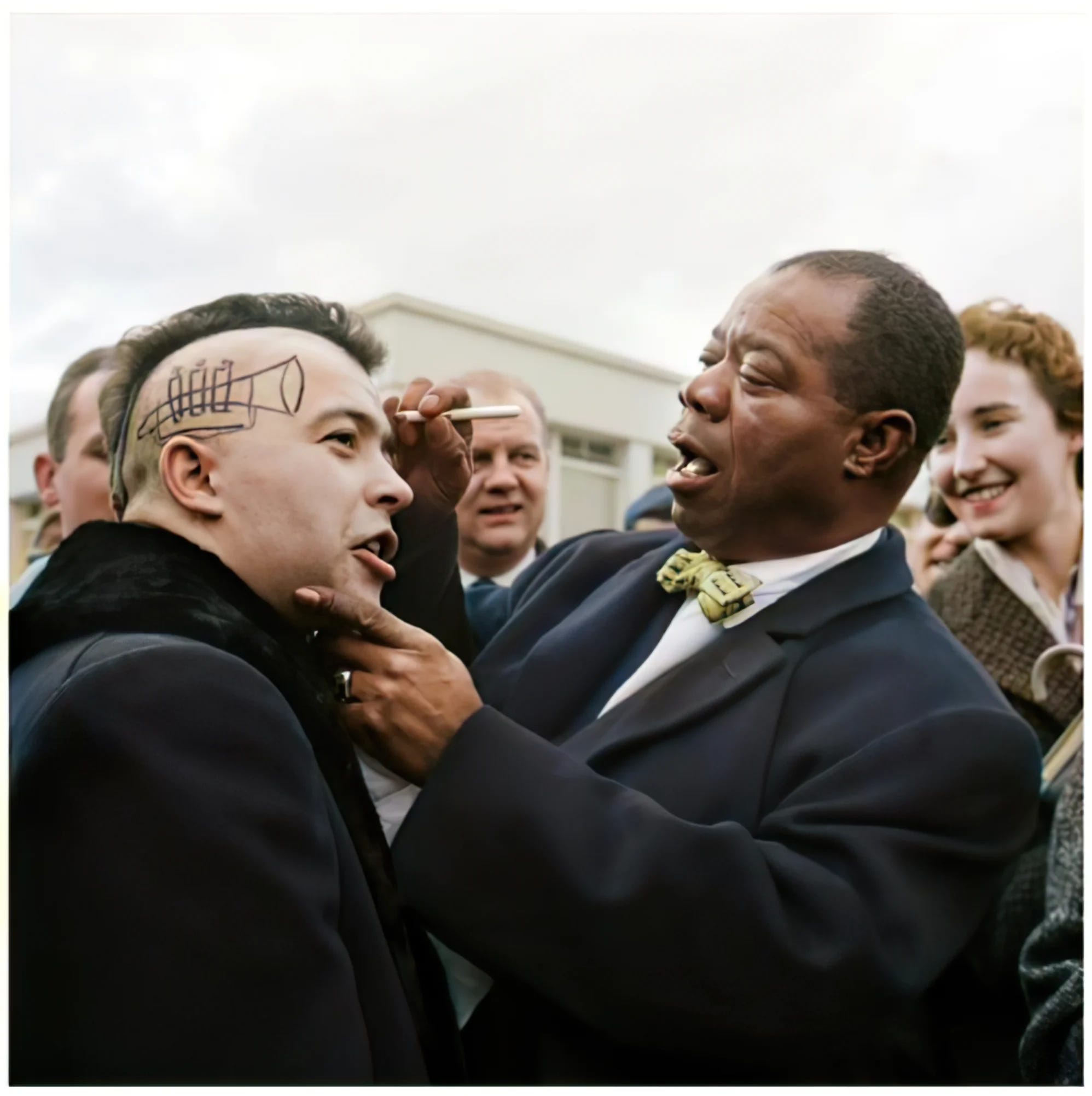
This photo is one I love[3]. How much does the man with the pen impact its intelligibility, and how much could we deconstruct the drawing with it still communicating the concept? Some of my cousins who I have shown this to have no clue who he is. The point here being that the information has a paradoxical contingency that the rationalist order struggles to resolve, outside of deeming it “art” in the pejorative. I am acutely aware of this yet still want to put forward some thoughts and have them heard.
“Sometimes it is not about talking and listening, it feels good to speak, and to be heard by someone you love”
It feels then that it is a will for control, and an uncomfortability in uncertainty that plagues me. The language, and sensations feel so clear in me, how can I mitigate all possible variables trying to get them over the chasm to you? First, I will perfect every idea, I will achieve omniscience; second, I will master all mediums; third, I will manage the consumption of everything I produce such that the context is perfectly aligned with the content. Failing that, I will let the lines delineating the self dissipate such that no-one can point fingers at me. Why does this terrify me? Perhaps it is ideas and sensations that are the boundaries of self, such that the more clearly I explicate them the more exposed my naked figure becomes.
How then do works of art, for it is all art, propel us into reveries and plunge us to sensory depths? Every motion outside of us (grant me that the conventional self exists) transmits some form of energy, of information. The media through which this occurs vary wildly and, in our world, fall into hierarchies given our intellectual framework for judging validity. Crudely, the further abstracted the medium is from post-Enlightenment rationalist science the less valid it is deemed. One may point to the leading artists heralded by the West, but I find an odd coincidence that these are often artists who are best interpreted literarily by commentators. So, an essay is more intellectually authoritative than a play, which is superior to a song, which dominates a painting etc. We end up with entire communities professing they only read non-fiction books as a claim to a more sincere pursuit of knowledge. Just as the philosopher’s hand is guided to communicate through the pen, so is the artist’s through the brush, and the sculptor through the chisel, and the disc jockey through the turntable needle. The radical artist, however, speaks a language that our society is not able to appreciate in the same way. Precisely because it is non-verbal it cannot be assessed and peer-reviewed in the scientific way that ordains validity to us. It does however communicate, immensely. But, because the medium through which valid commentary is given in our society is necessarily verbal there is not a consensus way to interpret the feeling on either side of the canvas. The radical artist speaks their language, fluently. The consumer may not. And if there is any dissonance it cannot be expressed, or hashed out, in a mutually understood way. If the consumer does not understand this is not strictly a problem, the artist is a person of confidence, they recognise that their art fulfils two purposes. It can be something understood in its integrity or close to it. It can also be a stimulus for the consumer’s own sensations in a way that was not explicitly conceived by the artist themselves. They paint the canvas, and in doing so offer a blank canvas to the observer.
This is the confidence then of the thinker and the trier
, not the knower. To express themselves, wanting this to be heard by others in full knowledge that it will not be consumed in its integrity but that the intent is pure even if the air it passes through is not. God will know that they have tried. The howls of Nina Simone in Sinnerman, Bobby Womack in Across 110th Street, and Benjamin Clementine in Then I Heard a Bachelor’s Cry[4] [5] [6]. I aspire to these feats. To whisper in a bird’s ear and then let it fly away. I feel incredibly exposed.
[1] Nietzche, Friedrich. Beyond Good and Evil. 1886.
[2] Williamson, Marianne. Our Deepest Fear. 1992.
[3] https://www.snopes.com/fact-check/louis-armstrong-drawing-head-france/
[4] Simone, Nina. Sinnerman. 1962.
[5] Womack, Bobby. Across 110th Street. 1972.
[6] Clementine, Benjamin. Then I Heard a Bachelor’s Cry. 2015.
Amazing. The year of the trier!!🕊️🕊️